
 This confirms the growing demand for inclusivity as a new social value. Accessibility means that everyone can receive services or assistance and use spaces without barriers, regardless of age, health condition, or life experience.
Despite the importance of this issue, the situation in the country remains challenging. In 2024, 93,000 infrastructure facilities were inspected, but only 20% of them met full accessibility standards. The digital sphere faces similar challenges: according to UNDP, only 24% of government websites comply with web accessibility requirements. At the same time, examples of high standards are demonstrated by "Diia.Education", "Diia.Accessibility", the National Bank of Ukraine, and the Electronic Court.
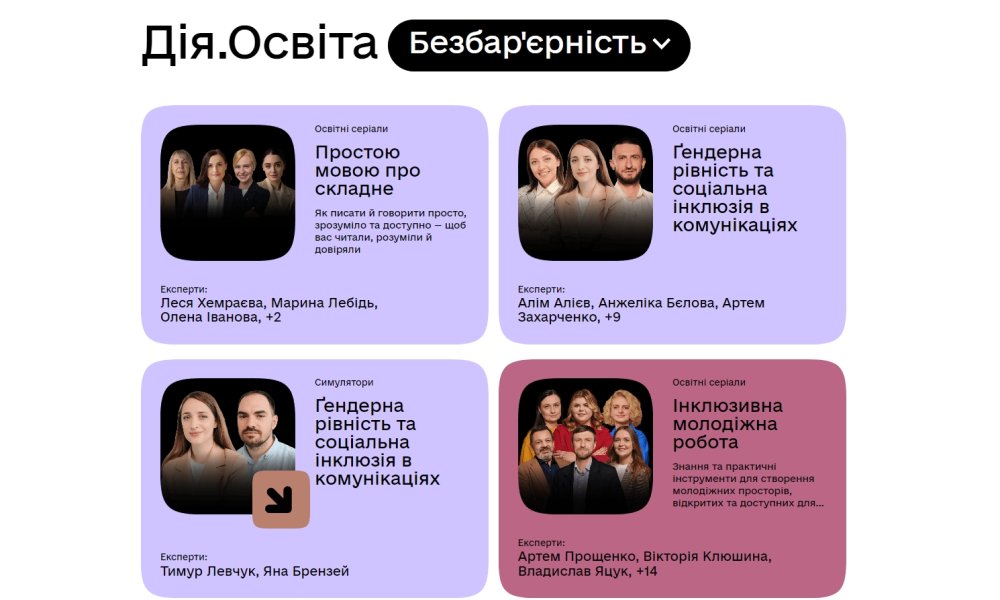
A distinctive feature of "Diia.Education" is its openness: learning is available in Ukrainian, sign language, with subtitles, and in an English version. This enables Ukrainian experience to be integrated into the global context while also helping citizens improve their language skills. The platform offers 12 free resources — series, simulators, and podcasts — that teach inclusive communication, explain how to create accessible services, and help understand different life experiences, from parenthood and military service to captivity or living with a disability.
Accessibility is studied most actively in Lviv region, though the dashboard records course completions even in temporarily occupied Sevastopol. Ukrainians abroad are also continuing their studies — mostly from Poland, Germany, the USA, and Indonesia.
This topic is of strategic importance: today about 3 million people with disabilities live in Ukraine, but only 14% of them are employed. In addition, 1.2 million veterans are returning to civilian life, and more than half face difficulties finding jobs. Overcoming these barriers could provide the economy with hundreds of thousands of professionals while at the same time fostering a culture of equality and respect.
Learn more about this training at the link.