
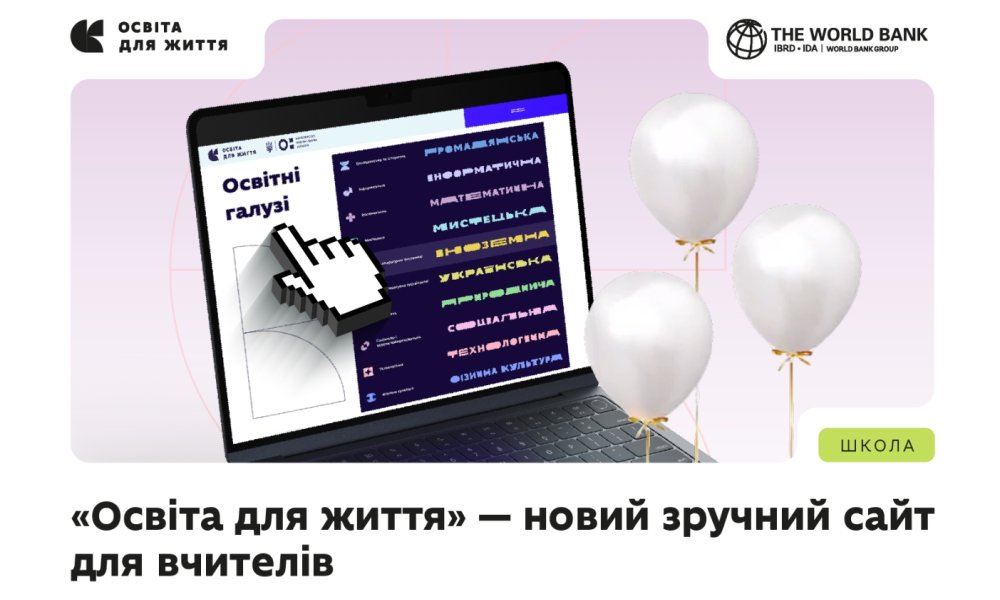
 The Ministry of Education and Science of Ukraine, together with the World Bank under the LEARN program and with the support of EdEra, has developed the digital platform “Education for Life” — a practical tool for teachers that helps plan the educational process, making it consistent and engaging.
A Unified Space for Educators
The platform brings together all key educational materials: state standards, curricula, methodological recommendations, examples of cross-disciplinary integration, assessment tools, and a library of competence-based exercises.
It does not impose a single approach but gives teachers the freedom to create their own teaching methodology, combining official standards with creative solutions.
- Convenient navigation across nine educational areas — with concepts, competencies, and standards for different education levels.
- Interactive standards — track a student’s progress from grades 1 to 12 and support competence-based learning.
- Exercise library — activities for developing critical thinking, creativity, initiative, environmental awareness, and more.
- Cross-disciplinary integration — examples of combining different subjects into joint projects.
- Assessment tools — guides for tracking learning achievements and adjusting teaching strategies.
Three pilot areas — Arts, Technology, and Natural Sciences — are being tested in 62 schools starting September 2025.
For Whom and Why
The platform is designed for teachers and methodologists who seek to systematically plan learning, integrate different subjects, create modern educational content, and develop students’ practical life skills.
The “Education for Life” Policy
This initiative is part of the New Ukrainian School (NUS) reform. Its goal is to make education practical, flexible, and life-oriented.
By 2030, the nine educational areas will serve as the foundation for updating curricula, textbooks, assessment approaches, and teachers’ professional development.
More information — available via the link.