
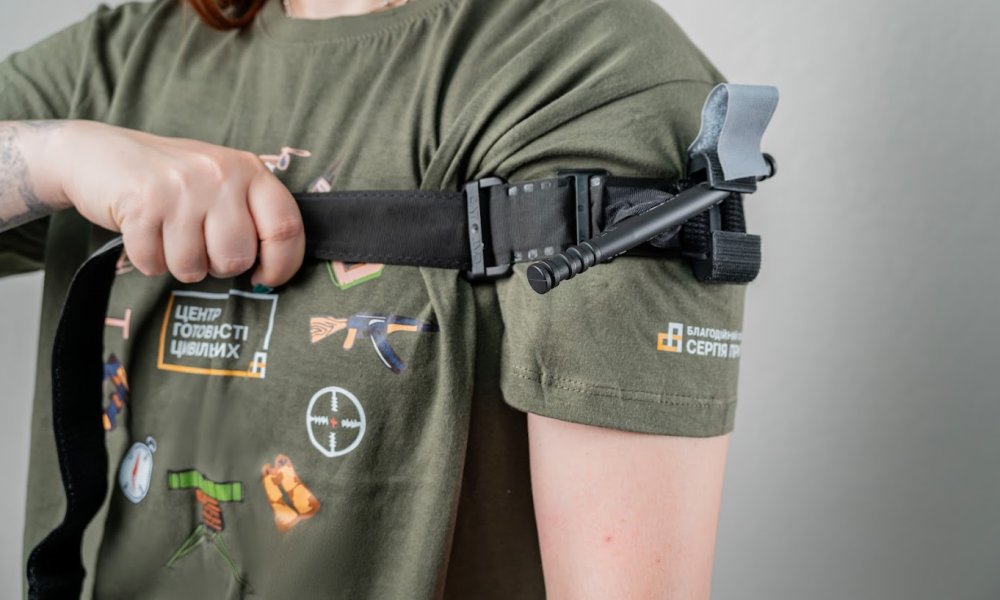
 Certified Tactical and Pre-Medical Medicine Trainings are regularly held in Poltava, where participants learn to act according to the M.A.R.C.H. protocol, stop bleeding, restore breathing, and save lives in critical situations. After completing the practical part, all participants receive certificates.
Civil Readiness Center
Since 2022, the Civil Readiness Center (CRC) has been conducting training sessions in Poltava on safety, first aid, firearms training, aerial reconnaissance, mine safety, and psychological resilience.
The CRC operates in 21 regions of Ukraine and has already held over 4,700 trainings for 80,000 participants.
In Poltava, the courses are divided into:
Theoretical modules: mine and explosive safety, mobilization readiness, psychological resilience, firearm handling rules, actions during shelling, and blackout preparedness.
Practical modules: first aid, firearms training, use of optics, working with drones and radios.
The training takes place in a workshop format with real-life scenarios, and participation is available for a voluntary contribution.
Ukrainian School of Rescue
The Ukrainian School of Rescue was established in 2022 in Kyiv and now also conducts its trainings in Poltava. Its main programs include “Tactical Medicine under TCCC-ASM Standards” and “Pre-Medical Aid for Civilians.”
The course lasts 8 hours and includes both theory (M.A.R.C.H., shock, trauma, hypothermia) and practice (tourniquets, bandages, occlusive dressings, airway management).
Upon completion, participants receive an internationally recognized certificate.
Guardians of Life
The “Guardians of Life” project has been operating for over 10 years, teaching modern first aid techniques.
The “Basic First Aid” course lasts 8 hours and covers cardiopulmonary resuscitation (CPR), defibrillator use, and actions in cases of stroke, heart attack, or loss of consciousness.
There is also a shorter “Stop the Bleed” course (3.5 hours), focusing on tourniquet and bandage application, as well as providing psychological support to victims.
Training includes video tutorials, mannequins, and interactive simulations. Upon completion, participants receive certificates.